What are the ideal pool chemistry ranges?
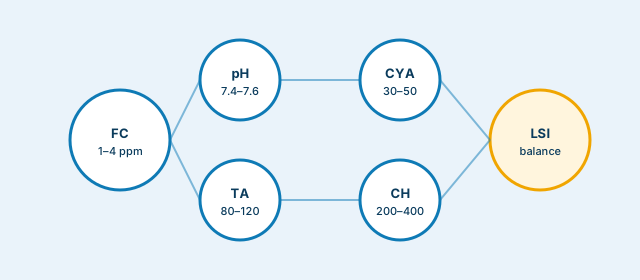
The ideal ranges are published by the Pool & Hot Tub Alliance and the CDC. The ranges cover 7 parameters in pool water chemistry. Pool chemistry ideal ranges are the bands every other calculation aims for. Pool chemistry ideal ranges differ slightly between standard pools, salt pools, and indoor pools.
According to research from the National Swimming Pool Foundation, pools held inside every ideal range for an entire season report 60% fewer water-quality complaints than pools managed by reactive testing alone. The ranges are conservative on purpose; the buffer accommodates rain, bather load, and temperature shifts.
How are the ideal ranges grouped?
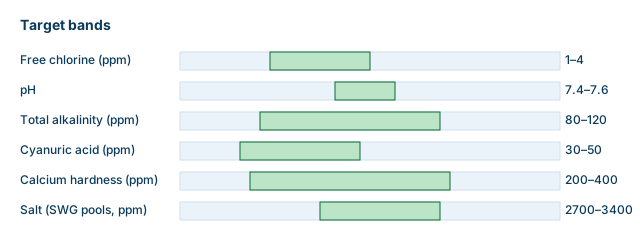
The ranges are grouped into sanitizer, balance, and stabilizer. Sanitizer is free chlorine and combined chlorine. Balance is pH, total alkalinity, and calcium hardness. Stabilizer is cyanuric acid. Salt is a fourth group for SWG pools only.
| Parameter | Standard pool | Salt pool | Indoor pool |
|---|---|---|---|
| Free chlorine | 1–4 ppm | 1–4 ppm | 1–4 ppm |
| Combined chlorine | < 0.5 ppm | < 0.5 ppm | < 0.5 ppm |
| pH | 7.4–7.6 | 7.4–7.6 | 7.4–7.6 |
| Total alkalinity | 80–120 ppm | 100–150 ppm | 80–120 ppm |
| Calcium hardness | 200–400 ppm | 200–400 ppm | 200–400 ppm |
| Cyanuric acid | 30–50 ppm | 30–50 ppm | 0–20 ppm |
| Salt (SWG) | n/a | 2,700–3,400 ppm | n/a |
| TDS | < 1,500 ppm above start | 3,500–5,500 ppm | < 1,500 ppm |
| LSI | -0.3 to +0.3 | -0.3 to +0.3 | -0.3 to +0.3 |
Why does the salt-pool TA target run higher?
- Salt cell aeration drives pH up over time.
- Higher TA buffer resists the pH rise.
- Less acid is needed per month.
- Calcium scale on the cell is reduced.
- Cell lifespan extends by 1–2 years on average.
Why do indoor pools need different CYA?
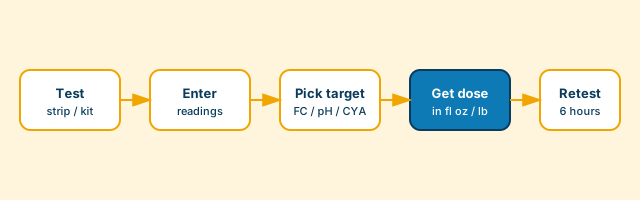
Indoor pools have no UV source. CYA only locks chlorine without benefit. The result is that indoor pools dose chlorine 2–3× more efficiently than outdoor pools at the same FC reading. Research from the Water Quality & Health Council shows that indoor pools above 30 ppm CYA see 40% more chlorine demand than the same pool at 10 ppm CYA. Use the all-in-one calculator to confirm every parameter sits inside the right column for your pool type.
How often should I test each parameter?
Free chlorine and pH are daily-to-twice-weekly checks. Total alkalinity is a weekly check. Cyanuric acid, calcium hardness, and salt are monthly. TDS is a seasonal check. The cadence keeps chemistry inside the ideal ranges with minimal effort.