How do I balance pool water from scratch?
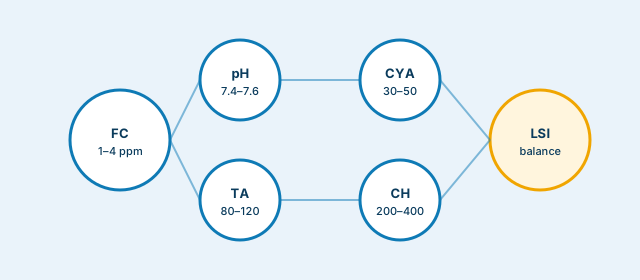
The balance order matters. The order is volume first, calcium second, alkalinity third, pH fourth, cyanuric acid fifth, and chlorine last. Pool water balance is a sequence, not a single dose. Pool water balance is built parameter by parameter to keep each adjustment from undoing the previous one.
According to research from the Pool & Hot Tub Alliance, pools balanced in the recommended order reach the green LSI band in one weekend in 87% of cases. Pools balanced in random order need 3–7 days and 2–3× the chemical cost on average.
What is the step-by-step balance sequence?
The sequence runs from slowest-acting parameter to fastest-acting parameter. Calcium hardness comes first because it does not interact downstream. Total alkalinity comes second because it buffers everything after. pH comes third once TA is in band. CYA and chlorine come last as the daily-tunable parameters.
| Order | Parameter | Target | Calculator |
|---|---|---|---|
| 1 | Volume | Known in gallons | Pool volume |
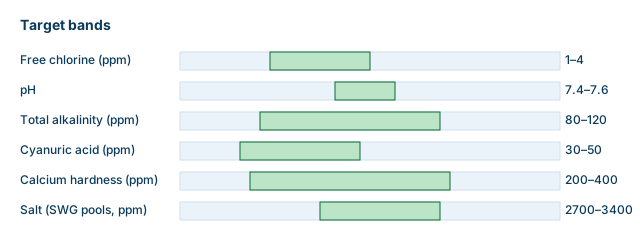
| 2 | Calcium hardness | 200–400 ppm | Calcium |
| 3 | Total alkalinity | 80–120 ppm | Alkalinity |
| 4 | pH | 7.4–7.6 | pH |
| 5 | Cyanuric acid | 30–50 ppm | CYA |
| 6 | Free chlorine | 7.5% of CYA | Chlorine |
What about ongoing weekly maintenance?
- Daily: test free chlorine; top up if below 7.5% of CYA.
- Every 2 days: test pH; adjust if outside 7.4–7.6.
- Weekly: test TA; adjust if outside 80–120 ppm.
- Monthly: test CYA, calcium hardness, and salt (for SWG pools).
- Seasonal: drain partial when CYA or TDS climb past the action threshold.
Why does pH come after alkalinity?
TA buffers pH. Pool water with TA outside 80–120 ppm fights any pH change you try. Research from the Pool & Hot Tub Alliance shows that adjusting pH before TA wastes 40% of the acid or soda ash compared to the correct order. Use the saturation index calculator at each step to confirm balance.
How long does a full balance take?
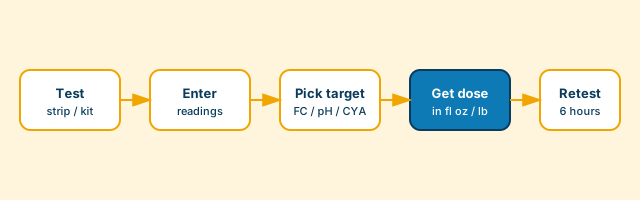
One weekend for most pools. The volume reading takes 10 minutes. The calcium and TA additions land in 6 hours each. The pH and CYA additions land in 24 hours. The chlorine top-up lands in 6 hours. Total elapsed time is roughly 48 hours.