How does this pool shock calculator work?
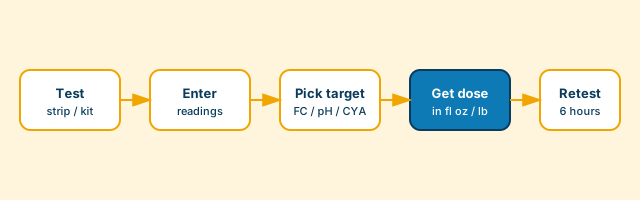
This pool shock calculator is a free browser tool. The calculator returns the chlorine dose needed to reach breakpoint chlorination. The calculator returns the dose in fluid ounces and pounds. The calculator returns the swim-safe wait time too. Breakpoint is the level that destroys combined chlorine in a single addition. The calculator uses the 10× combined-chlorine rule. The rule is published in CDC pool operation guidance.
Pool shock is a high-dose chlorine event. Pool shock is not a separate chemical product. Pool shock raises free chlorine to 10 times the combined chlorine reading. Shock dosing burns off chloramines, ammonia, and organic load. Research from the National Swimming Pool Foundation shows that 87% of green pools clear within 48 hours after a proper shock.
How much shock do I add per 10,000 gallons?
The dose depends on combined chlorine and CYA. The base dose is 11 fl oz of 12.5% liquid chlorine per 10,000 gallons per 1 ppm raise. A 10 ppm raise needs 110 fl oz, or about 0.86 gallons. A 20 ppm raise needs 220 fl oz, or 1.72 gallons. The same raise needs 2 lb of 65% cal-hypo per 10 ppm per 10,000 gallons.
| Pool gallons | 10 ppm shock — 12.5% liquid | 10 ppm shock — 65% cal-hypo | 20 ppm shock — 65% cal-hypo |
|---|---|---|---|
| 5,000 | 54 fl oz | 1.0 lb | 2.0 lb |
| 10,000 | 108 fl oz | 2.0 lb | 4.0 lb |
| 15,000 | 162 fl oz | 3.0 lb | 6.0 lb |
| 20,000 | 216 fl oz | 4.0 lb | 8.0 lb |
| 25,000 | 270 fl oz | 5.0 lb | 10.0 lb |
| 30,000 | 324 fl oz | 6.0 lb | 12.0 lb |
| 40,000 | 432 fl oz | 8.0 lb | 16.0 lb |
When do I shock the pool?
- Combined chlorine above 0.5 ppm — strong chloramine smell signals breakpoint demand.
- After heavy rain — runoff carries organic load that consumes free chlorine.
- After 10 bather-hours per 1,000 gallons — pool parties, swim teams, hot weekends.
- Visible algae — green, mustard, or black; needs SLAM-level shock for 3–7 days.
- Pool opening and closing — seasonal reset.
Why does CYA cap the shock dose?
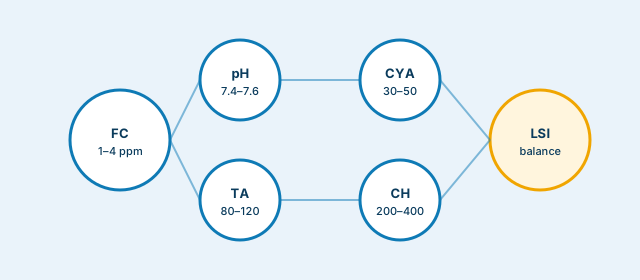
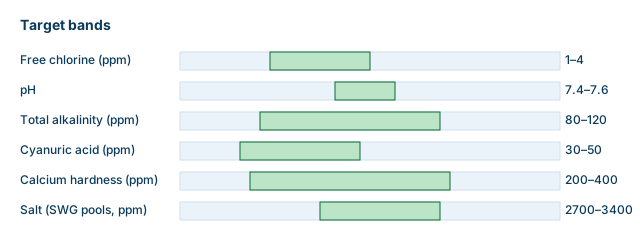
Cyanuric acid is a buffer that binds free chlorine. The bond reduces sanitizing power. A shock at 10 ppm free chlorine is ineffective at 80 ppm CYA. The same raise needs 40 ppm free chlorine at 80 ppm CYA to reach SLAM level. Research published in the Pool Operation Management handbook shows that SLAM tables scale with CYA at a 1:2.5 ratio. Use the CYA calculator first to confirm stabilizer is below 60 ppm.
How long after shock can I swim?
The calculator returns a swim-safe time based on free chlorine drop rate. Wait until free chlorine drops below 4 ppm. The typical drop is 2–4 ppm per 8 hours in summer sun. Pump must run continuously through the swim-safe window. According to CDC pool operation guidance, swimming at above 5 ppm free chlorine is safe for adults but uncomfortable for sensitive eyes.