What is cyanuric acid in pool water?
Cyanuric acid is the chemical that shields free chlorine from UV destruction. Cyanuric acid is also called CYA, stabilizer, conditioner, or pool sunscreen. Cyanuric acid is granular, off-white, and slow to dissolve. Pool cyanuric acid is the locked-chlorine reservoir that releases sanitizer back into the water on demand. Pool cyanuric acid extends free chlorine half-life by 8–10× in summer sun.
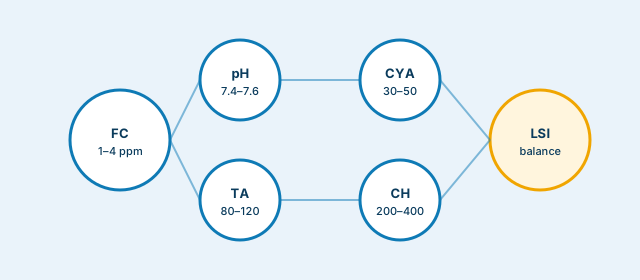
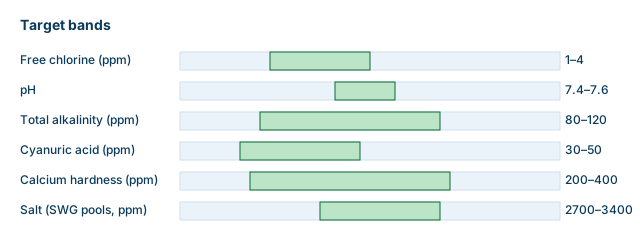
According to CDC pool operation guidance, the ideal CYA band is 30–50 ppm for outdoor pools. Research from the Pool & Hot Tub Alliance shows that pools at 0 ppm CYA lose 90% of free chlorine in 2 hours of summer sun. Pools at 40 ppm CYA lose only 25% in the same window.
How is cyanuric acid measured?
The test is turbidity-based. The reagent forms a cloudy precipitate proportional to CYA. The cloudier the sample, the higher the reading. Test strips give a rough range only. Research from the Pool & Hot Tub Alliance shows that turbidity readings carry ±10 ppm accuracy at typical residential ranges.
| CYA reading | Pool type | Status |
|---|---|---|
| 0–10 ppm | Indoor | Acceptable |
| 0–10 ppm | Outdoor | Too low; chlorine burns off |
| 30–50 ppm | Outdoor | Ideal |
| 60–80 ppm | Any | High; chlorine locked |
| >100 ppm | Any | Drain required |
What raises CYA — even unintentionally?
- Granular stabilizer — direct add; 13 oz per 10 ppm per 10,000 gal.
- Trichlor tablets — every 1 ppm chlorine adds about 0.6 ppm CYA.
- Dichlor shock — every 1 ppm chlorine adds about 0.9 ppm CYA.
- Refill water — usually 0 ppm CYA unless from a tested municipal source.
Why is high CYA hard to fix?
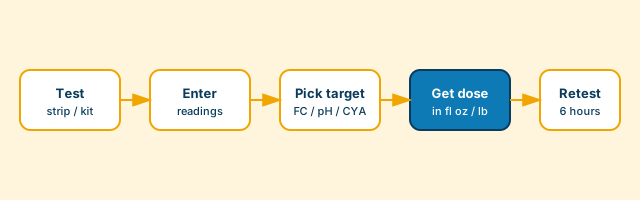
Cyanuric acid does not break down. CYA does not react with chlorine. CYA does not evaporate. The only ways to lower CYA are partial drain and reverse osmosis service. According to research published in the Water Quality & Health Council bulletins, "CYA reducer" products show inconsistent results in residential pools; the standard fix is a percent drain matching the percent reduction wanted. Use the CYA calculator to compute the dose to add — or the drain percent if the level is already too high.
Do indoor pools need CYA?
No. Indoor pools have no UV source. CYA only adds the lock penalty with no benefit. Hold indoor CYA at 0–20 ppm and dose chlorine without stabilizer.