PPoolChemCalc

What Is Free Chlorine: Definition, ppm Range, and How to Test It

The active sanitizer in pool water — HOCl plus hypochlorite ion.

Free chlorine is the active sanitizer form (HOCl + OCl⁻) measured in ppm, ideal at 1–4 ppm, and the only chlorine form that actually kills pathogens within seconds of contact.

Sanitizer 101 CYA-adjusted targets CDC-aligned

Quick reference card

Free chlorine targets
Ideal range1–4 ppm
Minimum (at 30 ppm CYA)2.25 ppm
Minimum (at 50 ppm CYA)3.75 ppm
Test methodDPD-1 drop test or strip
Action thresholdBelow 1 ppm → top up; above 10 ppm → wait

What is free chlorine in a pool?

Free chlorine is the form of chlorine still available to sanitize. Free chlorine is hypochlorous acid (HOCl) plus hypochlorite ion (OCl⁻). Free chlorine is the only sanitizer that actually kills pathogens. Pool water needs 1–4 ppm free chlorine at all times. Pool water with 0 ppm free chlorine grows bacteria within 4 hours.

According to CDC pool operation guidance, HOCl is the active killer. The ion form OCl⁻ is 80–100× weaker than HOCl. Research published in the Water Quality & Health Council bulletins shows that free chlorine at 1 ppm kills E. coli in under 1 minute when pH sits at 7.4.
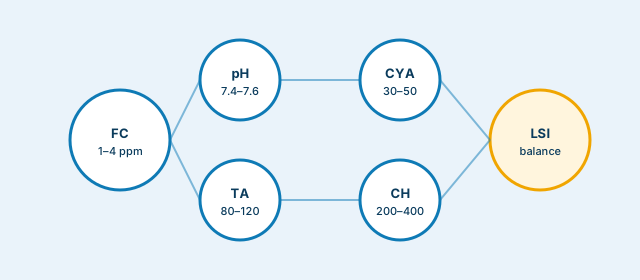
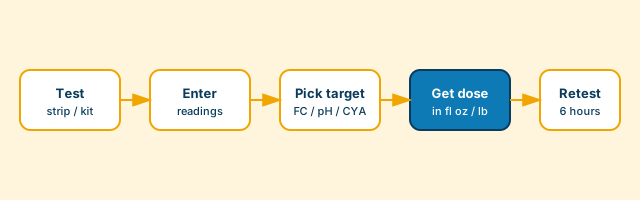
Diagram of pool water chemistry showing free chlorine, pH, total alkalinity, cyanuric acid, and calcium hardness as five connected dials.
Five interacting water-balance parameters. Move one and the others shift in response.
Step-by-step dosing flow: test water, enter readings, pick target, read calculated dose, add chemical, retest in 6 hours.
Standard dosing flow followed by every calculator on this site.
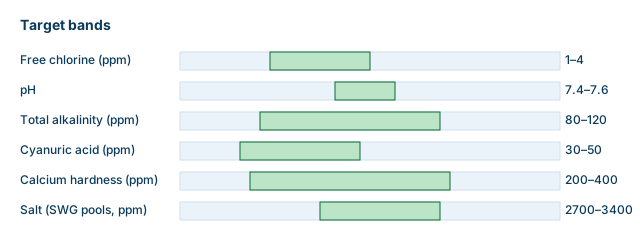
Reference band chart with ideal ranges: free chlorine 1 to 4 ppm, pH 7.4 to 7.6, alkalinity 80 to 120 ppm, CYA 30 to 50 ppm, calcium 200 to 400 ppm.
Target ranges this calculator uses by default. Override them in the form if your local code differs.

How is free chlorine measured?

The test is DPD-1 reagent or test strips. The result is read in parts per million. The DPD test gives free chlorine and total chlorine; the difference is combined chlorine. Test strips give a rough range only. Research from the Pool & Hot Tub Alliance shows that strip readings are accurate within ±1 ppm at best.

ReadingStatusAction
0 ppmUnsanitaryShock immediately
0.5 ppmBelow minimumTop up with chlorine
1–4 ppmIdeal bandMaintain
5–7 ppmHigh but safeWait for natural drop
>10 ppmOver-shockedDo not swim

What raises and lowers free chlorine?

  • Sunlight (UV) destroys 1–3 ppm per day in summer; CYA shields it.
  • Bather load consumes 0.2 ppm per swimmer-hour in a 20,000 gal pool.
  • Rain runoff adds organic load that consumes free chlorine.
  • High pH (above 7.8) shifts the HOCl/OCl⁻ balance toward weak OCl⁻.
  • Adding chlorine products raises free chlorine directly.

Why does CYA change the free chlorine target?

Cyanuric acid binds free chlorine. The bond reduces sanitizing power. The CDC publishes a 7.5% free-chlorine-to-CYA ratio as a daily minimum. At 30 ppm CYA the minimum is 2.25 ppm. At 50 ppm CYA the minimum is 3.75 ppm. Data shows that pools running below this ratio grow algae within 5–10 days. Use the chlorine calculator to land the dose, and the CYA calculator to confirm stabilizer is in range.

Frequently asked questions about free chlorine

What is the difference between free and total chlorine?

Total chlorine equals free chlorine plus combined chlorine. Free chlorine sanitizes; combined chlorine is the spent form that smells and irritates eyes. Subtract free from total to get combined.

Is 5 ppm free chlorine safe to swim in?

Yes for healthy adults. The CDC swim-safe ceiling for residential pools is 10 ppm. Children and sensitive skin may prefer to wait until free chlorine drops below 4 ppm.

Why does my free chlorine drop overnight?

Two main causes: CYA below 30 ppm leaves chlorine exposed to UV daytime burn-off, or chlorine demand from algae or ammonia. See the shock calculator if combined chlorine exceeds 0.5 ppm.

Can I measure free chlorine with a test strip?

Yes but with low accuracy. Test strips report a 1 ppm wide band; the DPD-1 drop test gives a sharper number. For chemistry decisions, use DPD.

Authoritative sources: Wikipedia: Chlorine, Wikipedia: Hypochlorous acid, CDC: pool disinfection guidance